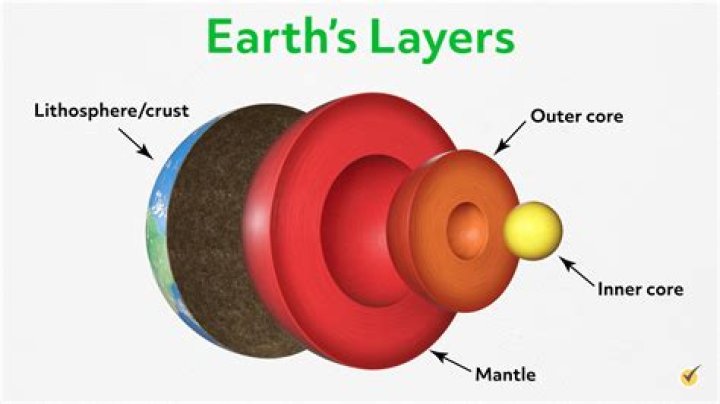
Similarly, it is asked, which of these best describes Earth's mantle?
Answer: The best description of Earth's mantle is it is made up of rock so hot that it flows. This layer is also called the asthenosphere. This Earth's mantle has a thickness that reaches 2,900 kilometers to wrap up the Earth's core.
Beside above, what is the Earth's mantle responsible for? The Mantle Earth's mantle plays an important role in the evolution of the crust and provides the thermal and mechanical driving forces for plate tectonics. Heat liberated by the core is transferred into the mantle where most of it (>90%) is convected through the mantle to the base of the lithosphere.
Also asked, what is the mantle of the Earth made of?
Above the core is Earth's mantle, which is made up of rock containing silicon, iron, magnesium, aluminum, oxygen and other minerals. The rocky surface layer of Earth, called the crust, is made up of mostly oxygen, silicon, aluminum, iron, calcium, sodium, potassium and magnesium.
What color is the Earth's mantle?
yellow
What is the difference between the upper and lower mantle?
The first difference between the upper mantle and lower mantle is their location. The upper mantle adjoins the crust to form the lithosphere, whereas the lower mantle never comes in contact with the crust. Temperature is one of the differences between the two upper layers of the mantle.Which description of Earth's mantle is true?
The mantle is the mostly-solid bulk of Earth's interior. The mantle lies between Earth's dense, super-heated core and its thin outer layer, the crust. The mantle is about 2,900 kilometers (1,802 miles) thick, and makes up a whopping 84% of Earth's total volume.Is the mantle solid or liquid?
The Earth's mantle is a layer of silicate rock between the crust and the outer core. Its mass of 4.01 × 1024 kg is 67% the mass of the Earth. It has a thickness of 2,900 kilometres (1,800 mi) making up about 84% of Earth's volume. It is predominantly solid but in geological time it behaves as a viscous fluid.What is the thickness of the crust?
The Earth's Crust is like the skin of an apple. It is very thin in comparison to the other three layers. The crust is only about 3-5 miles (8 kilometers) thick under the oceans( oceanic crust ) and about 25 miles (32 kilometers) thick under the continents ( continental crust ).Where is the mantle located?
The mantle is the layer located directly under the sima. It is the largest layer of the Earth, 1800 miles thick. The mantle is composed of very hot, dense rock. This layer of rock even flows like asphalt under a heavy weight.How much water is in the mantle?
Yet the total amount of water in the mantle is a highly uncertain figure. At the low end, the mantle might hold only half as much water as in the world's oceans, according to Schmandt and others. On the high end, the mantle could hold two or three times the amount of water in the oceans.How deep is the mantle of the Earth?
Earth's mantle extends to a depth of 2,890 km, making it the thickest layer of Earth. The mantle is divided into upper and lower mantle, which are separated by the transition zone.What is the composition of the crust?
Lutgens and Edward J. Tarbuck, Earth's crust is made up of several elements: oxygen, 46.6 percent by weight; silicon, 27.7 percent; aluminum, 8.1 percent; iron, 5 percent; calcium, 3.6 percent; sodium, 2.8 percent, potassium, 2.6 percent, and magnesium, 2.1 percent.What elements make up the mantle?
In terms of its constituent elements, the mantle is made up of 44.8% oxygen, 21.5% silicon, and 22.8% magnesium. There's also iron, aluminum, calcium, sodium, and potassium.Who discovered the mantle of the Earth?
Andrija MohorovicicWhat are the 7 layers of earth?
Each layer has its own properties, composition, and characteristics that affects many of the key processes of our planet. They are, in order from the exterior to the interior – the crust, the mantle, the outer core, and the inner core.What is a woman's mantle?
A mantle (from old French mantel, from mantellum, the Latin term for a cloak) is a type of loose garment usually worn over indoor clothing to serve the same purpose as an overcoat. For example, the dolman, a 19th-century cape-like woman's garment with partial sleeves is often described as a mantle.Is the mantle made of magma?
Magma is extremely hot liquid and semi-liquid rock located under Earth's surface. Earth has a layered structure that consists of the inner core, outer core, mantle, and crust. Much of the planet's mantle consists of magma. The high temperatures and pressure under Earth's crust keep magma in its fluid state.Why is the mantle hot?
The interior of Earth is very hot (the temperature of the core reaches more than 5,000 degrees Celsius) for two main reasons: The heat from when the planet formed, The heat from the decay of radioactive elements.Why is the mantle liquid?
This layer is the thickest composition of earth with 84% of the total volume of the earth . The mantle is in molten state of silicon rocks that are rich in magnesium and iron. So this temperature is also a factor that makes the mantle in a molten state.What are the layers of the mantle?
And remember that the lithosphere is composed of the earth's crust and the uppermost part of the mantle. The 3 main layers are the core, mantle and crust. The mantle is composed of the mesosphere and the asthenosphere and the uppermost part of the mantle.What are 5 facts about the mantle?
Planet Earth- The Mantle is the second layer of the Earth.
- The mantle is divided into two sections.
- The average temperature of the mantle is 3000° Celsius.
- The mantle is composed of silicates of iron and magnesium, sulphides and oxides of silicon and magnesium.
- The mantle is about 2900 km thick.